KEY TAKEAWAYS
- Piles vs fissure symptoms Bhosari: piles cause painless bleeding while fissures cause sharp, burning pain that lasts 30-90 minutes after stools.
- Haemorrhoids are swollen blood vessels; fissures are small tears in the anal lining — two completely different conditions requiring different treatments.
- Bright red blood on toilet paper appears in both conditions but the timing and nature of pain is very different.
- Over 1.2 crore Indians are estimated to have active anal fissures at any given time, many going undiagnosed (Industry estimate).
- Most fissures in adults are caused by chronic constipation or hard stools and can heal without surgery if caught early.
- Chronic fissures (lasting over 8 weeks) often need a minor surgical procedure to heal properly.
- A correct diagnosis from a specialist in Bhosari is the first step — don’t guess based on symptoms alone.
Bhosari Piles and Fissure Statistics 2025-2026
| Metric | Data Point | Source |
| Prevalence of anorectal disorders in India | Approx. 12% of adults have active anorectal conditions | Industry estimate |
| Piles cases in Pimpri Chinchwad region annually | Estimated 18,000+ new piles consultations per year | Industry estimate |
| Proportion of anal fissure patients misdiagnosed as piles | Approx. 30-40% initially misidentified | Industry estimate |
| Acute fissure healing with conservative treatment | 90% resolve within 4-8 weeks | NHP India |
| Chronic fissure requiring surgery | Approx. 10-15% of all fissure cases | Indian Journal of Surgery, 2023 |
| Cost of fissure treatment (Bhosari, Pune) | INR 8,000 to 25,000 | Industry estimate |
| Average duration before patients seek help | 6-9 months of symptoms before first consultation | Industry estimate |
Introduction: A Common Confusion With Real Consequences
Piles vs fissure symptoms Bhosari is one of the most searched questions by residents experiencing pain or bleeding in the anal region. Both conditions cause rectal discomfort and both involve the same anatomical area — but they are fundamentally different conditions requiring different treatments.
Getting the diagnosis wrong means getting the wrong treatment. A cream prescribed for piles does nothing for a fissure. An injection for fissures doesn’t help haemorrhoids. Dr. Prabhakar Sangale Piles Doctor in Bhosari regularly sees patients in Bhosari who have spent months treating the wrong condition.
What Are Piles? Understanding Haemorrhoids
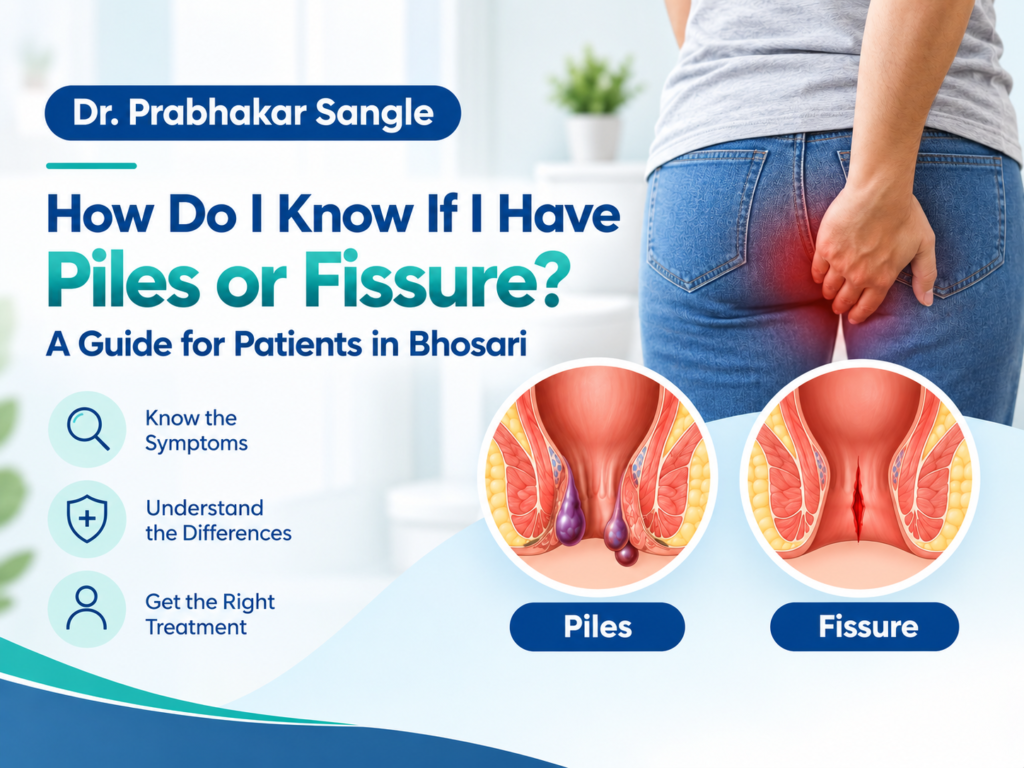
Piles (haemorrhoids) are swollen and inflamed blood vessels in the lower rectum and anus. Think of them as varicose veins of the anal canal. They develop when the veins in this area come under prolonged pressure from straining, pregnancy, chronic constipation or a sedentary lifestyle.
Internal haemorrhoids form inside the rectum. You can’t see or feel them unless they prolapse (push outside). External haemorrhoids form under the skin around the anus and can be felt as soft lumps.
Classic Symptoms of Piles
- Bright red blood on toilet paper or dripping into the toilet bowl — usually painless
- A soft, reducible lump around or near the anus
- Mucus discharge causing itching and wetness
- A feeling of incomplete emptying after passing stools
- Pain only when the haemorrhoid becomes thrombosed (a blood clot forms inside it)
What Is an Anal Fissure? Understanding the Tear
An anal fissure is a small but incredibly painful tear or cut in the thin, moist tissue lining the anus. Most fissures occur at the posterior midline of the anus (the 6 o’clock position if you picture a clock). They are most commonly caused by passing a hard, large stool that stretches the anal canal beyond its capacity.
What makes fissures so problematic is that the pain causes the internal anal sphincter to go into spasm. This spasm reduces blood flow to the tear, which prevents healing. It becomes a cycle — pain causes spasm, spasm prevents healing, poor healing causes continued pain.
Classic Symptoms of Anal Fissure
- Severe sharp or burning pain during and after passing stools — can last 30 to 90 minutes
- Bright red blood on toilet paper (small amount, usually a smear rather than dripping)
- Visible crack or tear at the anal opening
- Muscle spasm and tightness around the anus
- Skin tag near the fissure in chronic cases (sentinel pile)
- Fear of passing stools due to anticipated pain
Piles vs Fissure: The Key Differences
| Feature | Piles (Haemorrhoids) | Anal Fissure |
| Primary symptom | Bleeding (often painless) | Severe pain after stools |
| Blood appearance | Bright red, drips or covers stool | Small smear on paper, bright red |
| Pain duration | Usually minimal unless thrombosed | 30-90 minutes post-defecation |
| Visible on examination | Lump or prolapse visible | Tear or crack at anal margin |
| Cause | Raised venous pressure, straining | Hard stool, sphincter spasm |
| First-line treatment | Dietary change, topical cream, RBL | Stool softeners, GTN cream, sitz baths |
| Surgery required? | Only Grade 3-4 or failed conservative | Only if chronic (8+ weeks unhealed) |
| Typical patient | Anyone; more common 45-65 years | Common in young adults 20-45 years |
What Causes Confusion Between the Two?
Both conditions cause bright red rectal bleeding, both are related to bowel habits and both improve with a high-fibre diet. So why does confusion happen? The main reason is that many patients focus on the bleeding and ignore the pain pattern — which is actually the most telling difference.
Can you have both at the same time? Yes. It’s not uncommon to see a patient in Bhosari with Grade 2 haemorrhoids and a co-existing chronic fissure. This is exactly why a proper clinical examination by a specialist is the only way to get a definitive answer.
Treatment Approaches: Piles vs Fissure
| Treatment | For Piles? | For Fissure? | Notes |
| High-fibre diet and water | Yes | Yes | First-line for both conditions |
| Stool softeners (e.g., Ispaghula) | Yes | Yes | Reduces straining in both |
| GTN or diltiazem cream | No | Yes | Relaxes sphincter, improves fissure healing |
| Topical steroid cream | Yes | Limited | Reduces haemorrhoidal inflammation |
| Rubber band ligation | Yes (Grade 2) | No | Not applicable for fissures |
| Laser haemorrhoidectomy | Yes (Grade 2-3) | No | For haemorrhoids only |
| Lateral internal sphincterotomy | No | Yes (chronic) | Surgical option for fissure |
| Botox injection | No | Yes | Reduces sphincter spasm non-surgically |
The Bhosari Context: Why This Diagnosis Matters Locally
Bhosari is one of the oldest industrial areas of Pimpri Chinchwad with a large population of factory workers, supervisors and small business owners. Physical labour combined with irregular dietary habits and inadequate water intake makes this population particularly prone to both piles and fissures.
Dr. Prabhakar Sangale’s Bhosari clinic is ideally placed to serve residents of Bhosari, Moshi, Chikhali and Chakan. Many patients come after months of buying over-the-counter creams for ‘piles’ only to discover they actually have a fissure — or vice versa.
Getting the right diagnosis early means faster recovery, less money spent on the wrong medications and no unnecessary progression to surgery.
Frequently Asked Questions
Q: What is the main difference between piles and fissure?
A: Piles are swollen blood vessels in the anal canal that typically cause painless bright red bleeding. Anal fissures are small tears in the anal lining that cause intense burning or sharp pain lasting 30 to 90 minutes after passing stools. While both may cause bleeding, the pain pattern is the key distinguishing feature.
Q: Can piles and fissure occur at the same time?
A: Yes, it’s possible to have both piles and an anal fissure simultaneously. This is more common in patients with chronic constipation. A clinical examination by a qualified anorectal specialist is the only reliable way to diagnose both conditions accurately and plan appropriate treatment.
Q: Do both piles and fissures need surgery?
A: Not necessarily. Most acute fissures (present for less than 8 weeks) heal with medication and dietary changes. Grade 1 and Grade 2 piles often respond to conservative management. Surgery is generally reserved for chronic fissures (8+ weeks) and Grade 3-4 haemorrhoids that don’t respond to other treatments.
Q: How long does a fissure take to heal without surgery?
A: An acute anal fissure typically heals within 4 to 8 weeks with proper treatment including stool softeners, GTN or diltiazem cream, sitz baths and a high-fibre diet. According to NHP India, approximately 90% of acute fissures heal with conservative management. Chronic fissures may require lateral internal sphincterotomy or Botox injection.
Q: Is rectal bleeding always serious?
A: Bright red blood after passing stools is most commonly from haemorrhoids or a fissure, both of which are benign. However, rectal bleeding can also indicate polyps, inflammatory bowel disease or in rare cases colorectal cancer. Any persistent or unexplained rectal bleeding should be evaluated by a doctor to rule out serious causes.
Q: Where can I see Dr. Prabhakar Sangale in Bhosari?
A: Dr. Prabhakar Sangale has a clinic serving the Bhosari area as part of his multi-location practice across Pimpri Chinchwad and Pune. You can book a consultation through the website at drprabhakarsanglepilessurgeon.in. He also consults at Baner, Wakad, Pimple Gurav and Pimple Saudagar.
Conclusion
Understanding the piles vs fissure symptoms Bhosari patients experience is the critical first step towards getting the right treatment. Bright red blood plus minimal pain points to haemorrhoids. Bright red blood plus severe post-defecation burning almost always means a fissure.
Don’t spend months treating yourself with the wrong creams. A 15-minute consultation with Dr. Prabhakar Sangale can identify exactly what you have and start you on the fastest path to recovery.
Visit drprabhakarsanglepilessurgeon.in to book a consultation at the Bhosari, Baner, Wakad, Pimple Gurav or Pimple Saudagar clinic. Dr. Sangale holds MS (Ayurveda) and BAMS and has 7 years of specialised anorectal practice.
MEDICAL DISCLAIMER
This blog post is intended for general informational purposes only and should not be used as a substitute for professional medical advice. Symptoms of piles and anal fissure overlap with other conditions that require medical evaluation. Please consult a qualified anorectal surgeon for an accurate diagnosis and personalised treatment plan.

Dr.Prabhakar Sangle
Dr. Prabhakar Sangle is a highly experienced Anorectal Surgeon and Proctologist with over 14 years of overall clinical experience. He is the leading specialist at INDU Piles Speciality Laser Clinic, serving patients across Pimpri-Chinchwad, including Wakad and Pimple Saudagar, since 2016.
He specializes in advanced laser treatments for Piles, Fissure, and Fistula and is widely known for his expertise in Ksharsutra Therapy. Dr. Sangle focuses on minimally invasive, safe, and effective treatment methods to ensure faster recovery and long-term relief. His patient-first approach and precise diagnosis have helped hundreds of patients regain comfort and confidence.